
A system under pressure — and an opportunity for change
Across urgent and emergency care, services are increasingly supporting people at moments of acute mental health crisis. These are often the most vulnerable points in a person’s journey—where fear, confusion, trauma, or distress are at their peak.
A recent investigation by the Health Services Safety Investigations Body (HSSIB) into the safety of people experiencing a mental health crisis in urgent and emergency care highlights a consistent pattern: while intentions are compassionate, systems are not always designed to respond in ways that reduce distress and support recovery. This is not a question of individual practice alone. It is about how environments, systems, and workforce capability come together under pressure.
The opportunity is clear: to move from reactive crisis management toward relational, preventative, and person-centred approaches to safety.
When systems shape outcomes
The HSSIB investigation describes how people in crisis often move between multiple services—ambulance, emergency departments, mental health teams, and sometimes police—without consistent coordination.
At each point, small differences in response can significantly influence outcomes.
Where systems are stretched:
- Distress can be unintentionally escalated
- Staff may feel unequipped or unsupported
- Restrictive or containment-based responses can become more likely
Where systems are aligned:
- Early recognition reduces escalation
- Staff respond with confidence and clarity
- Safety is achieved alongside dignity and respect
This reinforces a key insight: safety is not only about responding to incidents, but about how systems either reduce or amplify distress.
Beyond containment: understanding distress
A central theme in the HSSIB findings is the tendency for services, under pressure, to default to managing immediate risk. This can lead to a focus on containment rather than understanding.
A more effective starting point is a shift in perspective: “What is this person experiencing, and what do they need right now?” As we know distress is often communication of factors such as
- Fear
- Pain
- Trauma responses
- Unmet needs
When this is recognised early, escalation is often preventable. When it is not, services can become caught in a cycle of:
- Increasing agitation
- Reduced options
- Greater reliance on restrictive interventions
This is not about removing risk—it is about responding in ways that do not increase harm.
The role of environment and experience
Urgent and emergency care environments can unintentionally contribute to distress, many of us have experience of Emergency Departments that are characterised by:
- Noise, crowding, and unpredictability
- Long waits without clear communication
- Limited access to appropriate, calming spaces
These factors are not incidental, they are active contributors to escalation or de-escalation. Safety, is not the absence of risk, It is, physical, psychological, relational and environmental.
A shared responsibility for safety
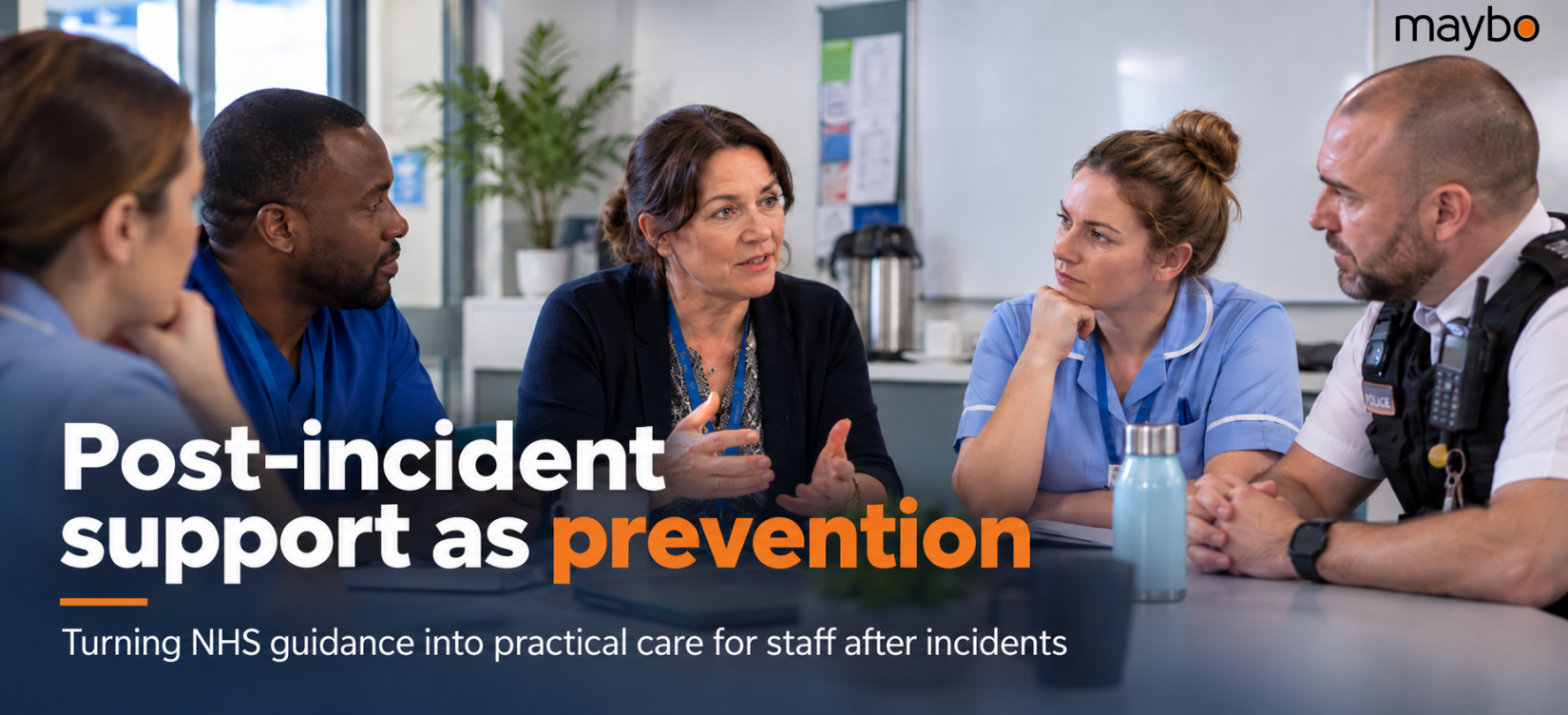
The investigation also points to variability in how different services and roles respond. Clinical staff and healthcare security officers both play vital, complementary roles. When aligned, clinical expertise supports understanding and care while security expertise can support safety, boundaries, and situational awareness. When disconnected:
- Responses can become fragmented
- Communication gaps increase risk
- The person in crisis experiences inconsistency
Safer outcomes depend on shared understanding, communication, and coordinated practice.
Considerations for Practice
For Clinical Staff
1. Recognise early indicators of distress
Notice changes in behaviour, communication, or emotional state. Early recognition creates more options.
2. Lead with relational engagement
Introduce yourself, explain what is happening, and provide reassurance. Clarity reduces fear.
3. Reduce uncertainty wherever possible
Explain waiting times and next steps. Revisit conversations as situations change.
4. Adapt the environment where you can
Small adjustments to noise, space, or privacy can significantly reduce distress.
5. Work collaboratively with security colleagues
Share relevant information and align on approach before escalation occurs.
6. Reflect beyond the incident
Focus on system learning: what contributed to distress, and what could be different next time?
For Healthcare Security Officers
1. See behaviour as communication
What may appear as aggression or resistance is often an expression of distress.
2. Prioritise de-escalation before intervention
Use presence, positioning, and communication to reduce tension and create space.
3. Maintain dignity and respect throughout
Interactions should minimise fear and preserve the person’s sense of self.
4. Work in partnership with clinical teams
Align responses with clinical understanding and agreed plans wherever possible.
5. Use proportionate and lawful responses
Ensure any intervention is necessary, proportionate, and the least restrictive option.
6. Contribute to a preventative culture
Your role is not only to respond to incidents, but to help reduce the likelihood of escalation.
How do we design safer systems?
The HSSIB investigation does highlights systemic challenges—and therefore systemic opportunities.
Improving safety for people experiencing mental health crisis is not about adding more control. It is about:
- Designing environments that reduce distress
- Equipping staff with confidence and capability
- Aligning teams around relational approaches
- Learning from patterns, not just incidents
When this happens, outcomes improve across the system:
- Reduced escalation
- Lower reliance on restrictive practices
- Improved staff confidence and wellbeing
- Better experiences for patients
Summary
People do not arrive in crisis as problems to be managed.
They arrive as individuals; often overwhelmed, often frightened, seeking safety, whether they can express it or not.
Safety is not only about what we do in moments of crisis, but about how well our systems are designed to prevent escalation, support staff, and respond with dignity.
That is where meaningful, sustainable change begins.