Ofsted has updated its guidance on the use of restraint, physical intervention and restrictions of liberty, reinforcing a clear direction for schools and other settings supporting children: effective practice starts with understanding the individual, not with the intervention used when things have already escalated.
Updated on 3 November 2026, the guidance reflects the Department for Education's revised approach to restraint and restrictive practices in schools. It explains how inspectors will consider the culture, planning and everyday practice surrounding restrictive interventions — not simply whether an individual use of force was technically permissible.
Read the updated Ofsted guidance
For education leaders, SEND professionals and those responsible for staff development, the message is significant.
The question is increasingly not just:
“Was this restraint lawful?”
It is also:
“What did we know about this child, what did we do to prevent the situation escalating, and what are we learning so that we can reduce the likelihood of it happening again?”
Understanding behaviour before responding to it
Ofsted's guidance places considerable emphasis on understanding individual children.
Inspectors are encouraged to consider whether staff understand a child's needs, communication, history and potential triggers, and whether that understanding informs the support they receive.
It reinforces a fundamental principle of person-centred practice: behaviour can communicate something about what a child is experiencing.
Distress may be influenced by anxiety, sensory needs, changes in routine, communication difficulties, previous experiences, demands that feel overwhelming, environmental factors or other unmet needs.
The appropriate response therefore cannot always be determined by looking at the behaviour alone.
Two children displaying superficially similar behaviours may require very different approaches.
That is particularly important when supporting children and young people with SEND, neuro-disability or communication support needs.
Ofsted's guidance states that effective assessment and planning based on an understanding of individual children's needs, personalities and wishes can help staff recognise signs of distress earlier — creating opportunities to support the child before restraint or restriction becomes necessary.
Moving from generic behaviour plans to genuinely person-centred support
Schools will commonly have behaviour policies, risk assessments and individual plans.
The important question is whether those documents genuinely help staff make better decisions in practice.
A useful person-centred plan should help the people supporting a child understand things such as:
- what is important to that individual;
- how they communicate when they are comfortable, anxious or distressed;
- situations that may increase their vulnerability or anxiety;
- known triggers and early warning signs;
- approaches that have previously helped;
- things staff should avoid doing because they may inadvertently escalate distress;
- reasonable adjustments that can reduce foreseeable difficulties;
- how the individual prefers to be supported;
- what should happen if risks increase; and
- what can be learned following an incident.
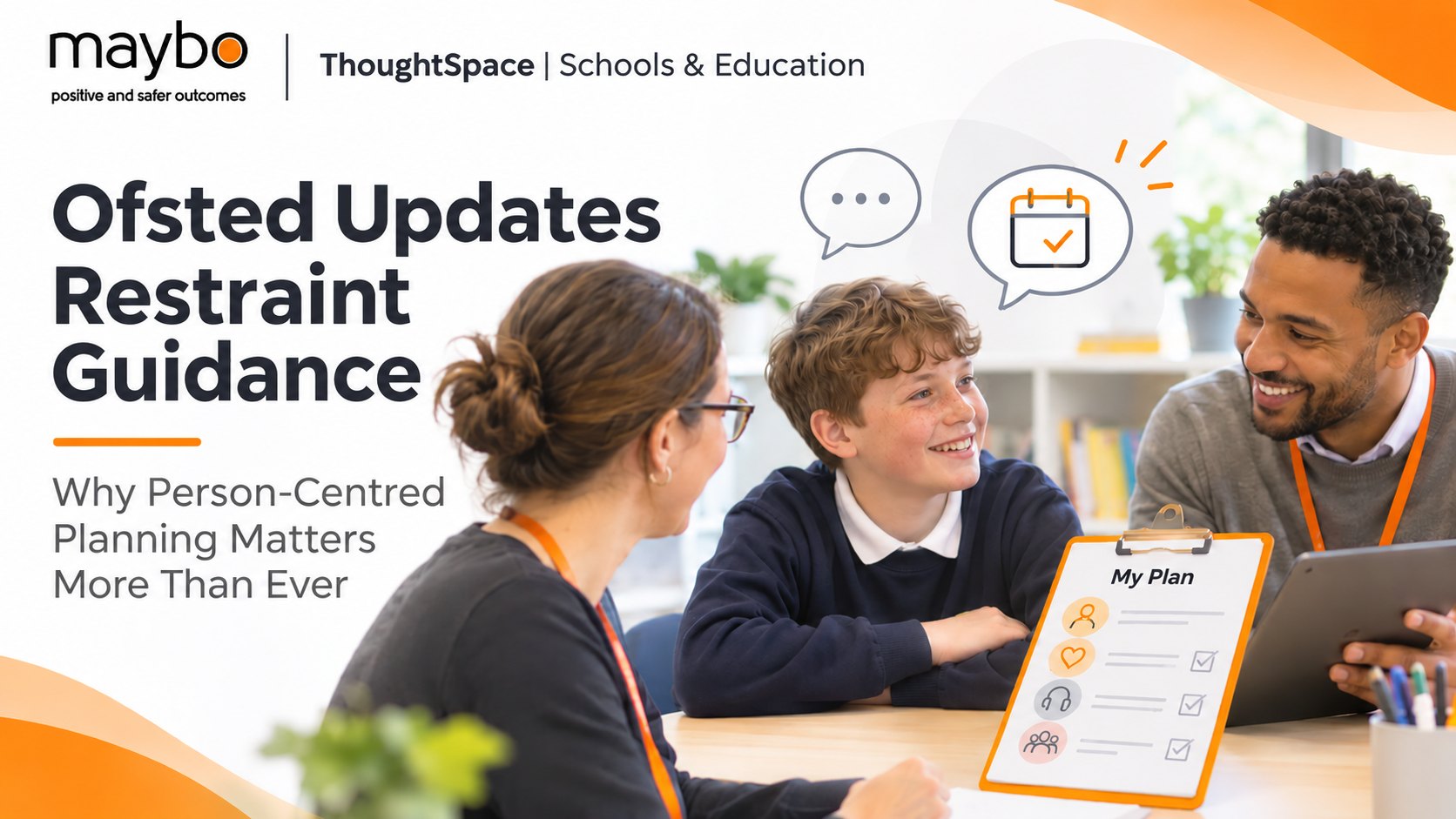
This is the principle behind Maybo's My Safety Plan, a person-centred planning tool designed to help professionals supporting individuals with additional needs develop tailored plans around safer support.
Rather than relying solely on generic responses to behaviour, My Safety Plan helps teams capture relevant information about the individual and translate that knowledge into practical guidance for the people supporting them.
The aim is not to predict every incident.
It is to improve the quality of information available to staff so that they are better placed to recognise emerging distress, adapt their approach and use the least restrictive response appropriate to the circumstances.
Explore Maybo's practical resources, including My Safety Plan
Least restrictive does not mean “do nothing”
There is an important distinction in Ofsted's updated guidance.
A focus on reducing restrictive practice does not mean that staff should never intervene physically.
Ofsted explicitly recognises that there will be circumstances where intervention is necessary to prevent harm.
If, for example, a child is about to move into immediate danger, staff would be expected to act.
The issue is proportionality.
Where restraint is necessary, Ofsted expects it to be used for the shortest possible period and where there is no less intrusive alternative capable of keeping people safe.
Inspectors may then consider why that intervention became necessary, its effect on the child and what could reduce the likelihood of a similar intervention being required again.
This is an important balance for schools.
A risk-averse culture in which staff are afraid to intervene can itself create harm.
But equally, environments in which physical intervention becomes a routine response to predictable behaviour may fail to address the underlying causes of repeated incidents.
Good practice sits between those extremes.
Staff need the confidence to act when necessary and the skills to recognise opportunities to avoid unnecessary escalation whenever possible.
Restrictive practice goes beyond physical restraint
Another important aspect of the Ofsted guidance is its broader consideration of restriction.
Physical holds are only one form of restrictive practice.
Inspectors may also consider practices involving isolation or seclusion, restrictions on movement, locked areas, equipment that limits mobility, intrusive observation or arrangements in which a child may perceive that they are unable to leave.
This matters because restrictive practices can sometimes become normalised.
A measure may originally have been introduced following a particular incident but then gradually become the default approach for an individual — or even for a wider group of children.
Ofsted makes clear that blanket restrictions should be questioned and that arrangements should reflect children's individual needs and development rather than being applied universally.
Again, individual planning becomes important.
A restriction that may be necessary for one person at one point in time may be unnecessary or disproportionate for someone else.
And because children's needs change, plans and restrictions need to change with them.
Recording an incident is not the same as learning from it
The updated guidance also strengthens an important message about incident recording.
Schools are required to record and report incidents involving restraint and seclusion in accordance with the applicable guidance. Ofsted notes that incidents should be recorded promptly and that parents should normally be informed when restraint has been used.
But recording should not become a purely administrative exercise.
If the same child experiences restrictive interventions repeatedly, leaders should be asking why.
- Are incidents occurring at similar times?
- Are there common environmental triggers?
- Are particular demands or transitions involved?
- Were early indicators of distress visible?
- Were staff following the individual's plan?
- Did an approach that usually works fail on this occasion?
- Has something changed for the child?
- Could a reasonable adjustment have reduced the likelihood of escalation?
- What did the child say about their experience afterwards?
And importantly:
What will we do differently next time?
That is where post-incident learning connects back to person-centred planning.
A good safety or support plan should not be static.
It should evolve as staff learn more about the individual.
From training to practice
There is also a wider lesson for staff training.
Providing employees with de-escalation or physical-intervention training is important, but training alone cannot create a person-centred culture.
Staff also need access to the information that allows them to apply those skills appropriately.
Someone may understand a range of de-escalation techniques but still struggle if they do not know that a particular child finds direct questioning overwhelming, requires additional processing time, becomes anxious in crowded environments or responds particularly well to a familiar activity.
Effective practice therefore connects several elements:
Understanding the individual → planning support → developing staff competence → recognising early indicators → responding appropriately → reviewing incidents → updating the plan.
This is the difference between training as an event and learning being transferred into everyday practice.
What should education leaders consider?
The updated Ofsted guidance provides an opportunity for schools and other education settings to review their arrangements.
Useful questions include:
- Are our plans genuinely individualised, or do they rely on generic descriptions of behaviour?
- Do staff understand what may sit behind a child's behaviour?
- Can staff recognise the individual's early signs of distress?
- Are reasonable adjustments clearly communicated?
- Do staff know which approaches tend to help and which may escalate the situation?
- Are restrictive practices being reviewed rather than simply repeated?
- Do we involve the child and their parents or carers appropriately?
- When incidents occur, does learning lead to changes in the child's plan?
- Can leaders demonstrate how staff training is being translated into safer everyday practice?
These questions matter because Ofsted's focus is increasingly on the experience of the child and the quality of practice surrounding an intervention, rather than on the terminology used to describe it.
Planning for safer, less restrictive support
Restrictive intervention will sometimes be necessary.
The objective should not be to pretend otherwise.
The goal is to create environments in which staff understand children well enough to recognise distress earlier, use appropriate preventative approaches and reserve restrictive interventions for circumstances where they are genuinely necessary and proportionate.
Person-centred planning is an important part of that process.
Tools such as Maybo's My Safety Plan can help professionals bring together knowledge about an individual's needs, communication, risks and preferred approaches so that the people supporting them have practical information they can use.
Because ultimately, the most effective response to an escalating situation may be something staff knew about the individual before the situation ever began.
Explore My Safety Plan and Maybo's practical resources for safer, person-centred support