Choose another country or region to
see content specific to your location

How a specialist independent school worked with Maybo to replace restrictive responses with prevention, relationships and trauma-informed practice.
The school is an independent special day school supporting children and young people with social, emotional and mental health needs and communication and interaction difficulties. Many of its learners are neurodiverse, and all have an Education, Health and Care Plan (EHCP).
The school takes a holistic and highly personalised approach to education, combining an adapted academic curriculum with therapeutic interventions, wellbeing support, social and life skills development and opportunities for learning outside the classroom.
Its rural setting enables learners to access a broad range of practical and outdoor experiences, including horticulture, Forest School, outdoor and adventure activities and equine studies. Small class groups, dedicated teaching support and an experienced wellbeing and therapy team help the school respond to each learner's individual educational, emotional and developmental needs.
Over recent years, the profile of pupils attending the school has changed significantly, with 84% of pupils now having a diagnosis of autism, 45% presenting with Social, Emotional and Mental Health (SEMH) needs, and an increasing number of pupils experiencing complex trauma, self-harm and communication difficulties.
Behaviour responded to at face value
Before embedding Maybo's approach, the school was experiencing around 12 Physical Interventions (PIs) each year.
Although staff were committed to supporting pupils, behaviour was often responded to at face value rather than by understanding the underlying causes. There was limited emphasis on restorative practice or analysing behavioural patterns, meaning situations could escalate more quickly to physical intervention.
Following the appointment of a new Headteacher, the school began reshaping its culture around relationships, trauma-informed practice and understanding behaviour as communication.
It needed a training partner whose approach aligned with these values and would help staff develop the confidence to prevent crises before they occurred.
Partnering with Maybo
Maybo provided a framework that complemented the school's evolving relationships and behaviour policy, placing prevention and de-escalation at the centre of practice.
Rather than focusing on restrictive interventions, Maybo equipped staff with practical strategies to prevent, understand and respond to distress.
Early signs – Prevention
Recognise the early indicators of distress and escalation before behaviour intensifies.
Trauma lens – Prevention
Understand the impact of trauma on behaviour and how it shapes a pupil's response to stress.
Relationships – De-escalation
Use communication and relationship-building as the primary tool to reduce conflict.
Low-level PI – De-escalation
Apply low-level physical interventions safely and proportionately when genuinely required.
Restrictive PI – Last resort
Ensure restrictive interventions remain a genuine last resort, never a default response.
Bespoke support for specialist settings
The programme is regularly reviewed alongside the school's changing needs.
During the latest review, all skills were confirmed as appropriate while outdated terminology was removed to better reflect current practice. Maybo also supported the school with practical resources, including the Personal Safety Planning Tool and guidance on recording physical interventions within its new recording system.
Beyond the classroom, Maybo delivered tailored de-escalation guidance for the school's land-based studies and horticulture provision, ensuring staff could confidently manage behaviour across different learning environments.
Physical interventions, year on year
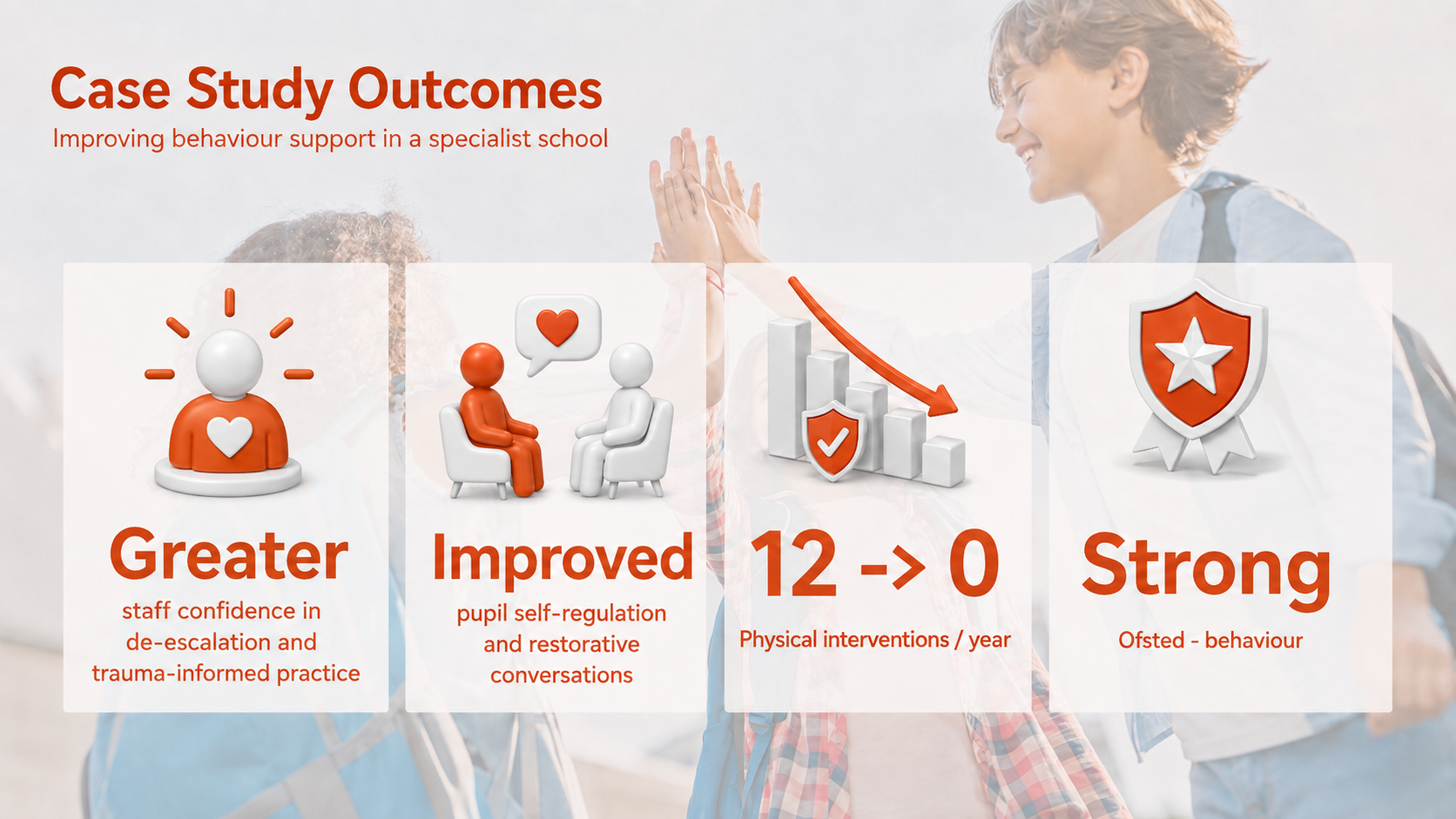
Since introducing Maybo alongside trauma-informed practice and the school's relationships and behaviour policy, recorded Physical Interventions have reduced year on year – from approximately twelve per year to zero in the current academic year.
“Staff feel significantly more confident recognising early signs of distress and intervening before behaviour escalates.”
— Reflection on staff practice
“Pupils increasingly return after incidents to initiate reflective conversations with staff – a major achievement.”
— Reflection on pupil regulation
“The culture has shifted from reacting to behaviour towards understanding the reasons behind it.”
— Reflection on school culture
“Ofsted awarded the school a Strong judgement for behaviour, recognising the effectiveness of the approach.”
— Most recent Ofsted inspection
What changed for staff and pupils
Staff report significantly greater confidence across every dimension of practice, with restrictive intervention now firmly established as a genuine last resort rather than a default response.
A summary of what Maybo delivered
In the Headteacher's words
“Maybo has helped us build a culture where behaviour is understood rather than simply managed. Staff now have the confidence to de-escalate situations earlier, and our young people are increasingly able to regulate their emotions and reconnect after difficult moments. Seeing our Physical Interventions reduce to zero demonstrates just how powerful a preventative, relationship-based approach can be.”
Headteacher
Specialist Independent School
A continuing partnership
The school and Maybo continue to review, refine and strengthen practice as the needs of pupils evolve – ensuring the framework remains aligned with the school's relationships and behaviour policy, and that prevention, de-escalation and relationship-based practice stay at the centre of everyday work.
If you would like to discuss how we can help you please get in touch with one of our experts today
Comments
[Disqus comments for content1136]