Choose another country or region to
see content specific to your location
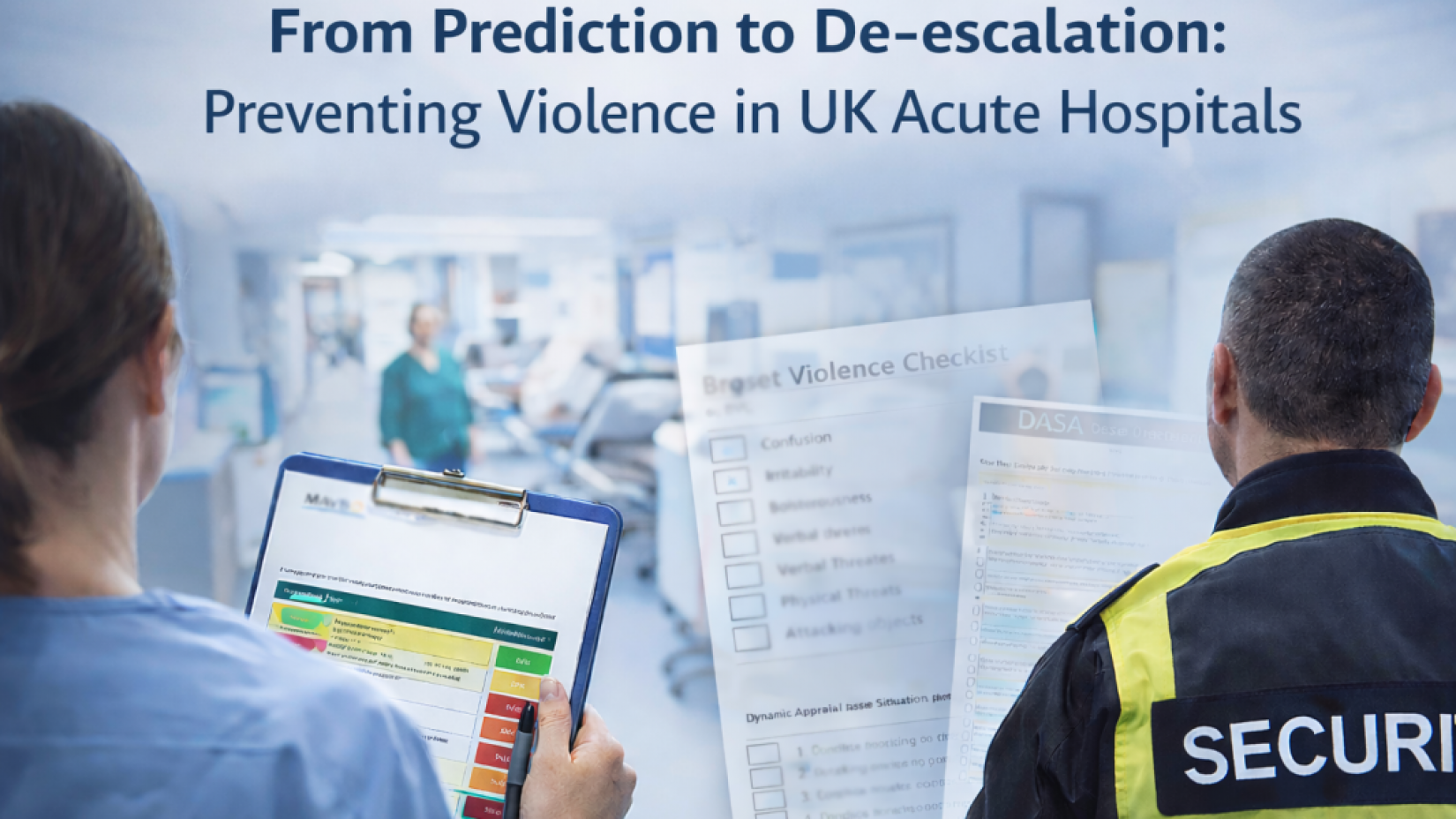
Violence and aggression remain among the most persistent safety challenges facing UK acute hospitals. Despite national standards, reporting requirements, and growing organisational awareness, frontline staff continue to experience high levels of violence, particularly in emergency departments, acute medical units, dementia care, and mental health interfaces within general hospitals. The question is no longer whether violence can be predicted, but how prediction is translated into prevention.
Recent evidence provides a clearer answer. An umbrella review published in BMC Public Health (Spencer et al., 2025) examined violence risk assessment tools designed to predict imminent patient violence, defined as risk within hours to days. The findings are highly relevant for the NHS and all acute healthcare providers: tools that focus on short-term, observable behaviour consistently outperform those relying on diagnosis, history, or long-term risk factors. More importantly, their value lies not in scoring risk, but in enabling earlier, proportionate intervention.
The review identifies the Brøset Violence Checklist (BVC) and the Dynamic Appraisal of Situational Aggression (DASA) as the most robust tools currently available. Both are brief, behaviour-based, and validated across emergency, acute, older adult, and psychiatric settings. Their strength is practical: they allow staff to recognise escalation early and act before harm occurs. The Aggressive Behaviour Risk Assessment Tool (ABRAT) also shows promise, particularly in medical-surgical environments, although its length makes it more resource-intensive.
A critical insight for UK acute hospitals is that these tools perform best when they focus on dynamic factors such as agitation, confusion, verbal hostility, or resistance to care. These are the very behaviours NHS staff encounter daily. By contrast, tools that prioritise static factors or long-term prediction offer limited value in fast-moving wards where patients, risks, and staffing change hour by hour.
However, the review is equally clear on a key limitation: risk assessment alone does not reduce violence. Tools are effective only when embedded within a wider system that links identified risk to consistent, skilled responses.
This is where many healthcare organisations struggle. Risk scores are recorded, but responses vary. One nurse escalates, another reassures, a third tolerates behaviour until it becomes unsafe. Inconsistent interpretation leads to inconsistent outcomes.
Maybo’s SAFER Dynamic Risk Assessment model addresses this gap. Rather than functioning as a standalone scoring tool, SAFER provides a continuous framework for recognising risk, understanding context, and selecting proportionate responses in real time. It aligns closely with the evidence base highlighted in the Spencer review, particularly its emphasis on observable behaviour, situational awareness, and early intervention.
In practice, BVC, DASA, and ABRAT can be highly effective triggers within an acute setting. They help staff recognise when risk is rising. Maybo’s SAFER model complements these tools by guiding what happens next.
For example:
Similarly, where ABRAT is used to identify patients at higher baseline risk on admission to medical or surgical wards, adopting the SAFER Dynamic Risk Assessment approach ensures that day-to-day interactions remain responsive rather than static. This is particularly important in older people’s services, delirium care, and wards managing cognitive impairment, where risk fluctuates rapidly.
For boards and senior leaders, the implication is clear. Violence reduction is not achieved through a single tool or policy, but through an integrated approach that combines:
The combination of validated tools such as BVC, DASA, or ABRAT with Maybo’s SAFER Dynamic Risk Assessment framework supports this integration. It moves organisations from retrospective reporting to proactive prevention, and from individual judgement to consistent, defensible practice.
UK acute hospitals are under increasing pressure to demonstrate effective violence prevention, not just compliance with standards. The evidence now supports a shift in focus: away from predicting who might be violent, and towards recognising when violence is becoming likely, and how staff can intervene safely.
Dynamic, behaviour-based tools provide the signal. Maybo’s SAFER approach provides the capability. Together, they enable safer care environments for staff and patients alike, grounded in evidence, practicality, and professional judgement.
In an NHS facing unprecedented demand and workforce strain, that combination is not optional. It is essential.
For a discussion about how Maybo's dynamic risk assessment and de-escalation approach can have a positive impact as part of a Violence Prevention & Reduction Strategy in your Hospital reach out to one of the Maybo team.
If you would like to discuss how we can help you please get in touch with one of our experts today