Choose another country or region to
see content specific to your location
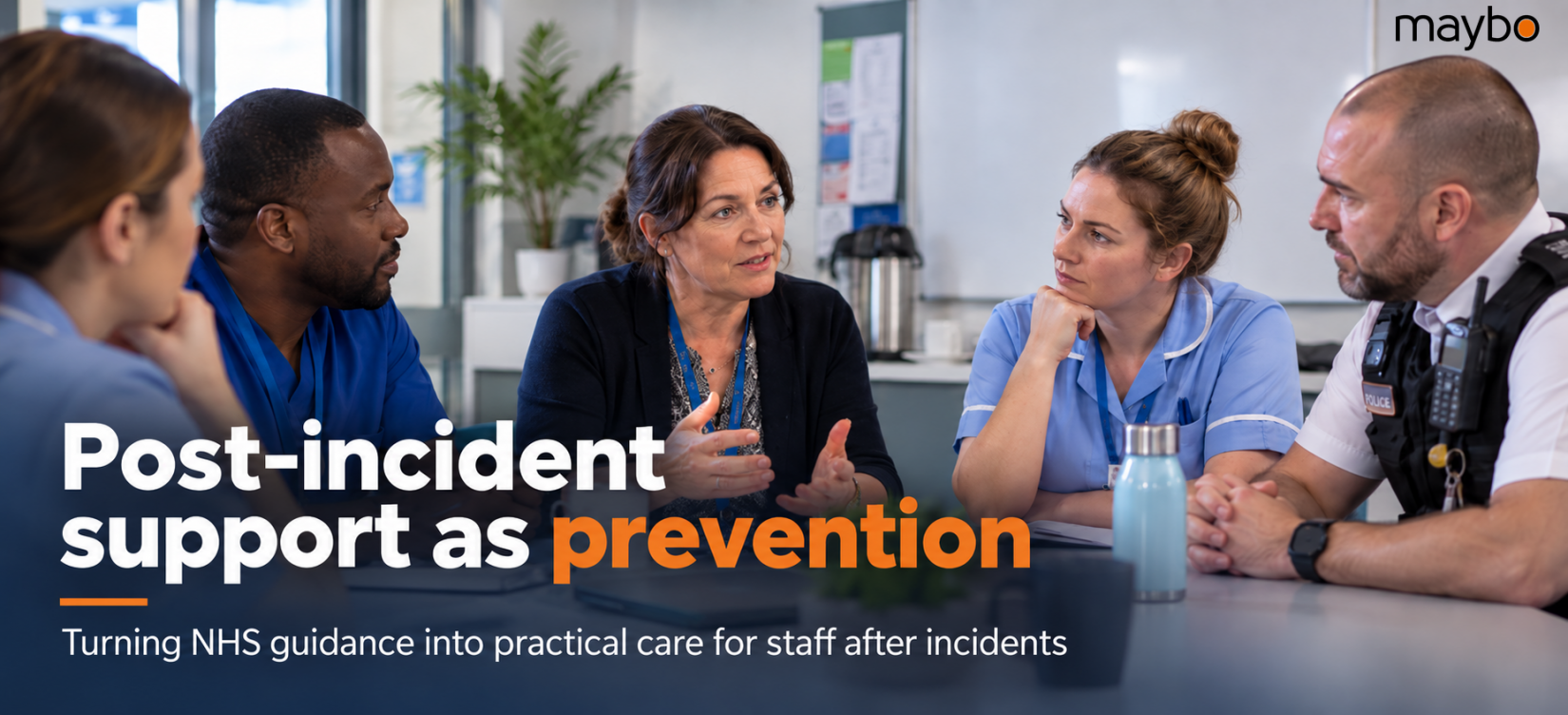
Turning NHS guidance into practical care for staff
Violence and abuse towards NHS staff should never be accepted as “just part of the job”. Even when physical injury is avoided, an incident can have a lasting impact on health and wellbeing. NHS Employers identifies distress, trauma symptoms, burnout and reduced job satisfaction among the potential consequences.
Post-incident support should not sit apart from an organisation’s approach to prevention. The NHS Employers Post-incident support framework supports implementation of NHS England’s Violence Prevention and Reduction Standard. Its central message is that prevention remains the priority, but staff also need timely, practical and equitable support when incidents occur.
For healthcare leaders and managers, the challenge is to translate that message into everyday practice: caring for the people affected, identifying ongoing risks and making changes that could prevent further harm.
The framework focuses on supporting staff following physical violence, verbal abuse, online or digital abuse, sexual assault and sexual harassment. It was developed to strengthen responses to violence and aggression from patients or members of the public.
It does not replace safeguarding, HR, disciplinary, legal or clinical incident-management procedures. It should work alongside those processes rather than compete with them.
In practice, this means connecting staff support, incident reporting and organisational learning while keeping their purposes clear. A conversation about someone’s wellbeing should not become an unexpected investigation interview.
NHS Employers highlights the value of multicomponent approaches, such as combining training, peer support and organisational commitment, rather than relying on isolated interventions.
The practical implication is that support should sit within a wider system of risk assessment, prevention, reporting and learning. It is not a substitute for addressing the conditions that expose staff to harm.
A useful question after an incident is therefore not only, “What support does this person need?” but also, “What needs to change to reduce the risk of this happening again?”
That might lead to changes in communication, staffing arrangements, the physical environment, care planning or access to assistance. These are examples to explore through a learning review, not assumptions about what caused a particular incident.
People respond differently to difficult incidents. The accompanying NHS Employers staff guidance recognises that distress may emerge later and that support should be tailored to the individual. It also makes clear that people who witness an incident may need support, even when they were not directly harmed.
For managers, this means avoiding assumptions based on someone’s outward appearance. A colleague who appears composed may still need time, reassurance or practical adjustments.
Ask what would help, agree how to keep in touch and revisit the conversation. Do not treat recovery as a deadline or assume that declining support today means it will not be needed later.
The framework describes stages of response, but these should not be presented as a compulsory sequence or a fixed recovery timetable. The approach below draws on those stages while keeping individual needs and the purpose of each conversation central.
The first priority is to make the situation safe and address injuries or urgent needs. The framework also includes basic psychological first aid: immediate emotional and practical support, alongside access to a private, non-public-facing space.
Discuss whether the person can continue their shift, whether duties need adjusting and whether they need help getting home safely. Consider who they would like with them and what support may be available once they leave work.
The starting point is not a detailed account of the incident. It is a simple question: “What do you need right now?”
The framework emphasises formal reporting through organisational processes and warns that delayed reporting can delay support. Its staff guidance also recognises the need for confidential or anonymous reporting options in relevant circumstances.
Make time and assistance available to complete reports, and explain what will happen next. Do not make immediate care dependent on a member of staff first completing paperwork.
Staff may also seek help from a trade union representative or Freedom to Speak Up Guardian. Explain the available routes and how information will be handled, rather than treating confidentiality and anonymity as interchangeable.
The framework calls this stage “demobilisation”: a brief conversation immediately after the incident or at the end of the shift, usually with a supervisor or suitably trained peer supporter.
Its priorities include safety and reassurance, clear information about what is happening next, and advice about further support.
Keep the conversation focused on the person. Acknowledge what happened, listen without judgement and agree the next point of contact. Make clear which immediate safety actions are being taken and who will provide updates.
The NHS Employers framework describes follow-up stages called “defusing” and “debriefing”. When applying these stages, organisations should tailor support to the individual rather than assume that everyone needs the same response or will recover at the same pace.
It is important to distinguish supportive follow-up from psychologically focused debriefing intended to prevent or treat post-traumatic stress disorder (PTSD). NICE guideline NG116 advises against the latter because the evidence shows no benefit and some indication of worse outcomes. A staff-support conversation should therefore not be presented as a treatment for trauma or a way to prevent PTSD.
For managers, the focus should be on listening, understanding what the person needs, offering practical assistance and agreeing further contact. Offer space to talk without requiring staff to recount distressing experiences or disclose personal emotional reactions. Where further assessment or treatment may be needed, help the person access the appropriate occupational health or healthcare service.
Keep organisational learning reviews distinct from these wellbeing conversations. An after-action review is intended to understand what happened and identify improvements, not to provide psychological treatment. Explain the purpose of each conversation so staff know what to expect.
The framework distinguishes an after-action review from psychological support. Its purpose is to understand what happened and identify improvements, with careful consideration of timing and facilitation.
Make that purpose explicit. A learning review can explore what was expected, what happened, what helped and what should change. It should not be presented as therapy, nor should staff be surprised by an investigative agenda in a meeting described as support.
Where urgent risks are identified, act on them promptly rather than waiting for a later review. Record agreed improvements, assign responsibility and check that actions are completed.
The accompanying NHS Employers staff guidance recognises that some staff face higher risks and that support should be fair, inclusive and culturally sensitive.
For leaders, this means asking more than whether a service exists. Can colleagues access it? Do they trust it? Are communication needs, personal circumstances and the sensitivity of the incident being considered?
Offer choices about how support is provided where possible. Ask what would help rather than making assumptions about a person’s needs or preferences.
Reporting and support arrangements should also explain how sensitive information will be handled. Confidentiality should be discussed clearly, not promised in absolute terms.
For contracted services such as security, agree in advance who will make contact after an incident, what support is available and how it can be accessed. The framework recognises arrangements such as a contractor’s occupational health service or a service level agreement.
The practical aim should be to prevent people falling between organisations. Consider agency staff, students, volunteers and others working alongside the team when reviewing local arrangements, rather than assuming they can access the same services as directly employed staff.
These arrangements should identify who owns the follow-up and how relevant learning will be shared appropriately.
The framework gives supervisors, line managers and trained peer supporters important roles in the response. That makes preparation essential.
Managers need clear protocols, time to follow up and access to advice when a situation exceeds their role or competence. The framework’s accompanying manager and staff checklists provide a practical starting point.
Training should help managers listen, recognise when further help may be needed, explain available support and maintain contact. It should not leave them feeling responsible for diagnosing trauma or providing psychological treatment.
Managers who have themselves been affected by an incident should also have someone to turn to.
Post-incident support belongs within a wider approach to preventing violence, reducing distress and promoting safer care.
Maybo provides training, tools and guidance to help organisations prevent and manage conflict, strengthen de-escalation skills and respond professionally when situations become difficult. Its risk-reduction approach also recognises the importance of supporting people after incidents.
When reviewing your arrangements, consider how staff training, manager capability and learning from incidents connect with your existing occupational health and specialist support pathways.
To discuss how Maybo can support prevention-focused practice and safer responses in your setting, get in touch with our team.
If you would like to discuss how we can help you please get in touch with one of our experts today
Comments
[Disqus comments for content1150]