Choose another country or region to
see content specific to your location
Why NHS Staff Safety Needs Better Language
By Simon Whitehorn, Maybo Lead Consultant
Violence, threats, racism, sexual harassment and abuse towards NHS staff must never be treated as “part of the job”. No nurse, paramedic, healthcare assistant, receptionist, doctor, porter, security officer or cleaner should go to work expecting to be assaulted, intimidated or degraded while providing care.
So when MPs, unions and professional bodies call for action on violence against healthcare staff, the concern is both understandable and urgent. NHS England’s Violence Prevention and Reduction work recognises the need for safer systems, better data, shared learning and practical action across the NHS.1
The question is not whether the NHS should act. It must. The question is whether “zero tolerance” is still the right language, or whether it was ever the right language at all? Has it helped reduce harm, or has it become a soundbite that allows us to sound serious while avoiding the harder work of prevention?
“Zero tolerance” is attractive because it is clear, forceful and emotionally satisfying. It appears to draw a firm line. It reassures staff that leaders are on their side and tells the public that abusive behaviour is unacceptable.
But as a violence reduction strategy, it is weak. It does not explain what causes violence. It does not distinguish between very different types of incidents. It does not tell staff what will happen after they report abuse. It does not improve the environment in an overcrowded emergency department, reduce long waits, address corridor care, strengthen staffing levels, build team confidence, improve post-incident support or create meaningful accountability.
It tells us what we condemn. It does not tell us what we will change. That distinction matters.
Healthcare violence and aggression are not a single phenomenon. They may include deliberate assault, racist abuse, sexual harassment, intimidation, intoxication, fear, pain, confusion, cognitive impairment, acute mental distress, trauma responses, frustration with delays, or relatives overwhelmed by fear. Staff need protection from all of these risks, but they do not all require the same response.
A racist assault is not the same as a person with dementia striking out during intimate care. A calculated threat is not the same as panic in a frightened child. A sexually abusive patient requires firm consequences and safeguarding action. A confused patient resisting essential treatment may require skilled, lawful, compassionate support. All create risk. All matter. But a single slogan cannot do justice to their differences.
This is where the current debate becomes confused. In March 2026, Professor Nicola Ranger, General Secretary and Chief Executive of the Royal College of Nursing, responded to the NHS Staff Survey by saying; “What staff need isn’t more talk of ‘zero tolerance’.”
That was the right diagnosis. It recognised that NHS staff do not need another slogan. They need reporting systems that work, leaders who act, employers who follow through, and visible consequences where harm occurs. Professor Ranger also connected violence and abuse to wider NHS pressures, including under-resourced services and waiting times.2
Yet only months later, the public debate drifted back to calls for the enforcement of “zero tolerance”. That tension matters. It shows how easily a serious issue becomes trapped in language that even its advocates know is insufficient.
The contradiction is not that the RCN is wrong to defend nurses. It is not. The contradiction is that the analysis points towards prevention, transparency, investment and accountability, while the slogan pulls us back towards enforcement language that cannot carry the complexity of the problem.
In other words: the thinking is muddled because the language is muddled.
The phrase also implies that violence is happening because organisations are tolerating it. That may be partly true in the sense that staff often feel incidents are normalised, under-reported or poorly followed up. But the deeper issue is rarely a formal tolerance of violence. It is weak systems.
Staff report incidents and do not always see change. Teams work in environments where flashpoints are predictable but not redesigned. Leaders say abuse is unacceptable, while staff continue to experience it daily. Policies exist, but staff confidence in action remains low. In some settings, the burden falls back onto individual resilience rather than organisational prevention.
That is not a tolerance problem. It is an implementation problem. And implementation requires much more than a slogan.
NHS England’s Violence Prevention and Reduction Standard is more useful than “zero tolerance” because it provides a risk-based framework to support safe and secure working environments and to help organisations identify areas for action and measure progress over time. That is the language of a system. “Zero tolerance” is the language of a press release.
This is not a new critique. In 2005, Brodie Paterson, David Leadbetter and Gail Miller argued in Beyond Zero Tolerance that approaches to workplace violence in health and social care had too often focused on training as the primary response, as though violence were mainly a problem of interpersonal conflict. They argued instead for a cultural shift that recognises the organisational and societal roots of violence and adopts a public health approach.
That insight remains highly relevant over 20 years later. If we frame violence as simply the behaviour of a “violent patient” or “abusive member of the public”, the response becomes individualised: security, restraint, warning letters, removal, prosecution, exclusion. Some of those responses are sometimes necessary. But they are downstream.
A public health approach asks different questions. What patterns are we seeing? Where are incidents most likely to occur? What environmental factors increase risk? Which staff groups are most exposed? Are racialised, disabled or female staff experiencing disproportionate harm? Are waits, communication failures or service pressures contributing to escalation? What happens after an incident? What changes as a result?
Those are prevention questions. They are also accountability questions.
The irony is that the NHS has better language than “zero tolerance”. NHS Protect’s Meeting Needs and Reducing Distress was guidance on preventing and managing clinically related challenging behaviour in NHS settings. Its purpose was to provide practical strategies to identify, assess, understand, prevent and manage clinically related challenging behaviour by preventing or minimising distress, meeting people’s needs, and ensuring high-quality care within a safe environment.6
That framing is far more useful than “zero tolerance”. It does not excuse harm. It does not ask staff to tolerate abuse. It does not minimise the seriousness of violence. Instead, it asks the practical questions that help prevent escalation.
What need is not being met? What distress is present? What clinical condition, cognitive impairment or psychological factor may be influencing behaviour? What environmental or communication triggers are increasing risk? What can be changed before the situation deteriorates? What support do staff need to respond safely and proportionately?
A member of staff is not made safer by a poster saying “zero tolerance” if the organisation has not understood why incidents are happening, what triggers them, where risk concentrates, how early warning signs are recognised, and what support follows after harm. Staff are safer when services are designed to meet needs earlier, reduce distress before it escalates, and respond decisively when risk becomes immediate.
This is why the return to “zero tolerance” language feels like a step backwards. It moves the debate away from the more appropriate questions “what need, distress, environment, pathway or behaviour is creating risk, and what are we doing about it?” and back towards a blunt declaration that cannot guide practice.
The NHS does not need to choose between staff safety and understanding distress. The best guidance has always recognised that they belong together.
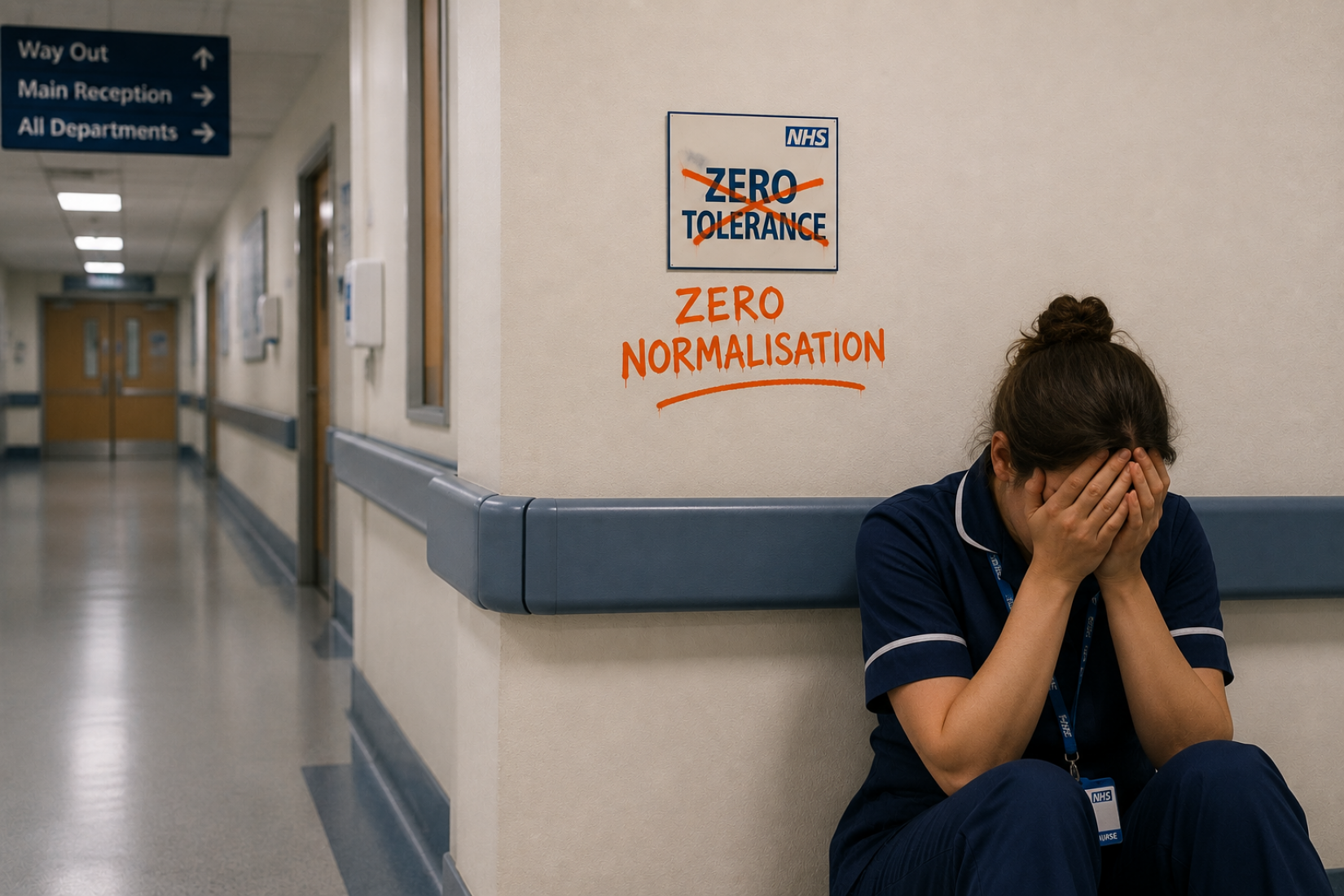
The NHS does not need softer language. It needs more accurate language. A better frame would be zero normalisation.
There should be zero normalisation of violence, threats, racism, sexual harassment or abuse towards healthcare staff. There should be zero acceptance of staff being told to put up with harm. There should be zero complacency when reports are made and nothing changes. But there cannot be zero context, zero clinical judgement, zero curiosity about root causes or zero responsibility for the environments, pressures and systems in which risk escalates.
“Zero normalisation” keeps the moral boundary clear without pretending that every incident is the same or that enforcement alone will prevent harm. It allows us to say that violence and abuse are unacceptable, staff must be protected, deliberate and discriminatory behaviour must have consequences, distress and vulnerability must be understood, services must design risk out wherever possible, employers must act and every incident should lead to support, learning and prevention.
That is a stronger position than zero tolerance because it is both principled and practical.
This is particularly important in healthcare because staff safety and compassionate care cannot be treated as competing priorities. Maybo’s work in ambulance and healthcare settings reflects this. Many incidents involve people who are frightened, confused, intoxicated, unwell or in crisis, and the challenge is not choosing between safety and compassion but delivering both consistently under pressure.
That does not excuse violence. It clarifies the task. The aim is to prevent harm while recognising that distress, crisis and risk often coexist. This means equipping staff to recognise early signs of escalation, set boundaries, protect themselves lawfully, de-escalate where possible, disengage where necessary, and respond proportionately when risk becomes immediate.
Maybo’s risk reduction approach across health, care and ambulance settings is prevention-led: understand risk early, build staff confidence, reduce escalation, and align training with wider organisational strategy rather than treating training as a standalone event. That is the level of clarity missing from “zero tolerance”.
If leaders want to protect NHS staff, the message should be firm, but more precise:
Violence, threats, abuse, racism and sexual harassment towards NHS staff must never be normalised. Staff must be supported to report harm, protected when risk is present, and confident that employers will act. Services must combine clear consequences for deliberate or discriminatory behaviour with prevention, de-escalation, environmental design, post-incident support and learning.
This is not weaker than zero tolerance. It is stronger because it names the work.
It also avoids the false choice that often damages this debate: the idea that we must either defend staff or understand patients. We must do both. Staff safety is essential to patient safety. A frightened, unsupported, injured or burnt-out workforce cannot provide safe care. But a healthcare system that responds to every expression of distress as wilful aggression will also create harm.
The task is not to excuse violence. The task is to prevent it.
The phrase “zero tolerance” has had decades to prove itself. Yet violence, abuse, harassment and intimidation remain persistent features of NHS working life. If the language were enough, staff would already be safer.
They are not.
NHS staff deserve more than statements of condemnation. They deserve safe systems, skilled teams, visible leadership, reliable reporting, post-incident care, environmental risk reduction, meaningful consequences, and a culture that refuses to normalise harm.
The NHS has already recognised, in documents such as Meeting Needs and Reducing Distress, that safer care depends on understanding need, reducing distress, preventing escalation and managing risk proportionately. That is a far richer and more practical frame than “zero tolerance”.
So let us be clear: abuse is unacceptable. Violence is unacceptable. Racism and sexual harassment are unacceptable. Staff must be protected.
But let us also be honest: zero tolerance is not a violence reduction strategy. The NHS should stop reaching for soundbites and start using language that supports the work that actually reduces harm.
Not zero tolerance.
Zero normalisation. Zero complacency. Meeting needs. Reducing distress. Prevention first.
If you would like to discuss how we can help you please get in touch with one of our experts today
Comments
[Disqus comments for content1127]