Choose another country or region to
see content specific to your location
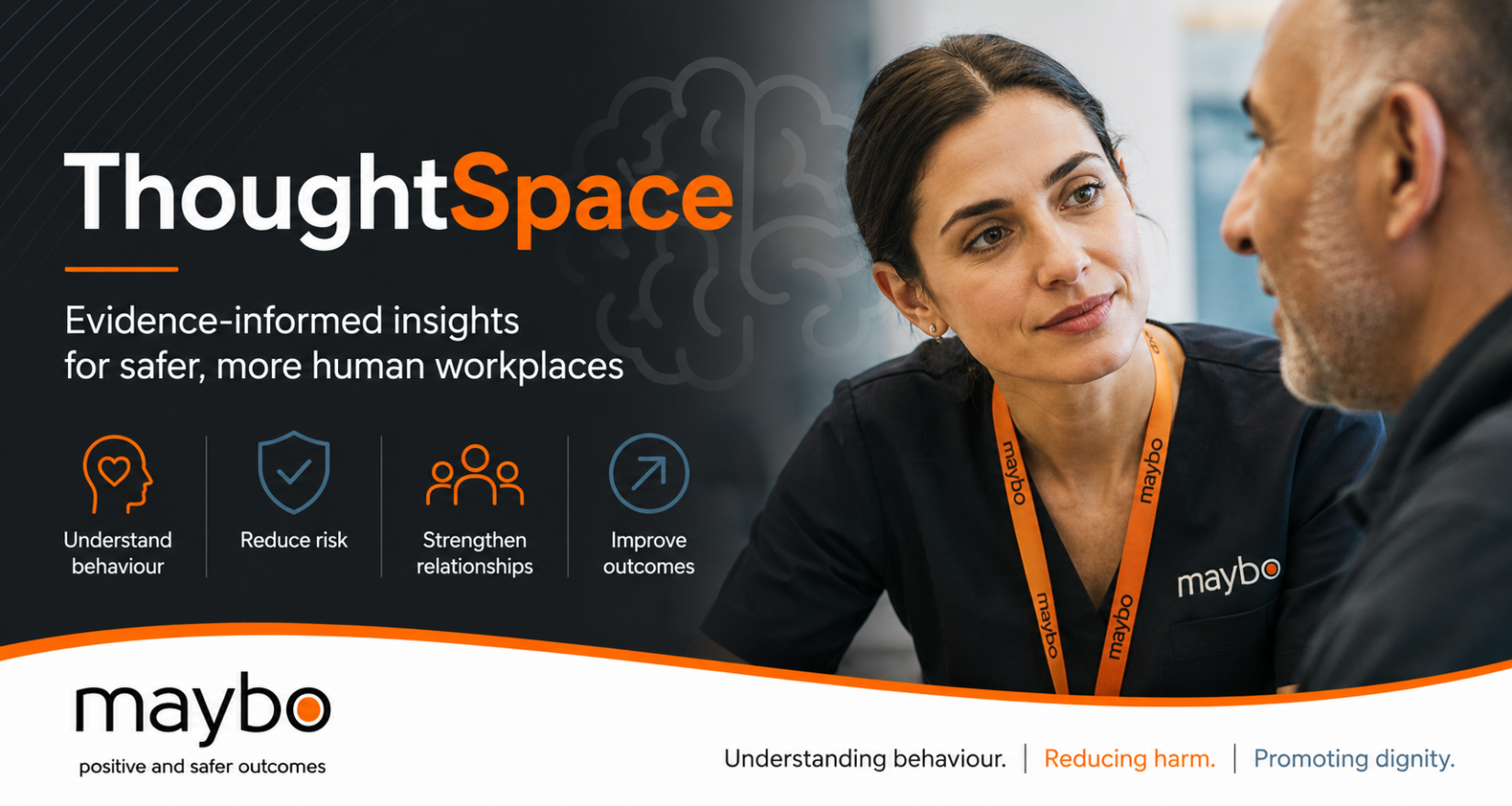
Understanding the neuroscience behind distress, conflict and safer interactions
When conflict occurs, it's tempting to ask:
"Why did they behave like that?"
Perhaps a more helpful question is:
"What was happening in their brain at that moment?"
Modern neuroscience increasingly shows that much of human behaviour—particularly during periods of stress or distress—is driven not by careful reasoning, but by rapid, automatic survival systems that evolved to keep us alive.
Understanding these systems doesn't excuse aggression or unsafe behaviour. Rather, it helps us understand why people sometimes respond in ways that seem irrational, disproportionate or out of character—and why our own responses can unintentionally escalate situations.
For anyone working in health, social care, education, security or customer-facing roles, this understanding provides an important foundation for preventing conflict before it develops into crisis.
The brain's first priority isn't being rational—it's staying alive.
Human beings like to think of ourselves as rational decision makers.
In reality, our brains evolved first and foremost to detect danger and keep us alive.
For hundreds of thousands of years, failing to recognise a threat could have fatal consequences. As a result, our nervous system became exceptionally good at identifying potential danger—often long before we consciously realise what's happening.
This means that before the brain asks:
It first asks a much simpler question:
When the answer is uncertain, survival takes priority.
Psychologist Daniel Kahneman described two broad modes of thinking in his landmark book Thinking, Fast and Slow.
The first is fast, automatic and intuitive.
The second is slower, reflective and analytical.
Much of our everyday behaviour relies on these rapid, automatic processes because they allow us to respond quickly without consciously analysing every situation.
This isn't a flaw.
It's one of the reasons humans have survived.
However, under pressure these automatic systems become even more dominant.
The result is that we become more reactive and less reflective.
The brain contains several structures involved in detecting and responding to danger. One of the most important is the amygdala, which rapidly evaluates emotional significance and potential threat. If danger is detected, the brain initiates a cascade of physiological changes.
These changes are remarkably effective if we're avoiding a moving vehicle or escaping genuine physical danger. They are considerably less helpful when we're trying to resolve disagreement, listen carefully or make balanced decisions.
Daniel Goleman popularised this process as an "amygdala hijack"—a situation where emotional survival responses temporarily overwhelm reflective thinking.
When stress increases, thinking decreases. The prefrontal cortex is responsible for many of the abilities we associate with good judgement:
Research consistently demonstrates that acute stress reduces the effectiveness of these executive functions. People often describe this experience afterwards by saying:
"I wasn't thinking."
From a neuroscience perspective, that's often exactly what happened. Their brain wasn't broken. It was prioritising survival over reflection.
Conflict is often driven by perceived threat—not actual danger.
One of the most important insights from behavioural science is that the brain responds to perceived threat.
The threat does not have to involve physical violence.
People may experience threat when they feel:
Research by Naomi Eisenberger and Matthew Lieberman demonstrated that social rejection activates many of the same brain regions involved in experiencing physical pain. This helps explain why seemingly minor interactions can provoke unexpectedly strong emotional reactions. When people feel psychologically unsafe, their nervous system often responds as though they are physically unsafe.
When someone becomes highly distressed, providing more information or stronger instructions rarely restores calm. In fact, it can sometimes increase the sense of threat.
This is because we are attempting to communicate with the person's reasoning brain while their survival system is dominating their behaviour.
Before people can solve problems, regulate emotions or consider alternatives, they first need to experience sufficient safety for those higher-level thinking systems to re-engage.
This is why effective de-escalation is not primarily about saying the perfect words. It is about reducing perceived threat.
The same biology applies to all of us. Perhaps the most important lesson is that these processes are universal. They don't only apply to "challenging" people.
They apply equally to staff, managers, clinicians, teachers, security professionals and leaders.
When someone shouts at us...
Our own heart rate increases.
Our own attention narrows.
Our own thinking becomes less flexible.
Conflict often becomes an interaction between two nervous systems attempting to protect themselves.
Recognising this allows us to pause, regulate ourselves and respond intentionally rather than react automatically.
This understanding supports a significant shift in how organisations approach behaviour.
Rather than asking:
We begin asking:
These questions underpin relational approaches that focus on dignity, respect, curiosity and understanding. They also align closely with current NHS England guidance, which places increasing emphasis on culture, human rights, reducing restrictive practices and recognising the importance of relational care.
Looking behind behaviour is not about lowering expectations or accepting violence.
It is about recognising that people make better decisions when they feel safe enough to use the parts of the brain responsible for reflection, empathy and self-control.
As neuroscience continues to develop, one message becomes increasingly clear:
For nearly 30 years, Maybo has helped organisations create safer workplaces by supporting people to understand behaviour, reduce conflict and respond to distress with confidence, empathy and professionalism. Our evidence-informed approach combines practical skills with a deep understanding of human behaviour, helping organisations build cultures where safety, dignity and respectful relationships go hand in hand.
Understanding how the brain responds to stress is only the beginning. The real difference comes from creating workplaces where staff have the confidence, skills and organisational support to recognise distress early, reduce perceived threat and respond safely when situations become challenging.
At Maybo, we work with organisations across healthcare, social care, education, security, transport and customer service to build safer, more relational approaches to conflict prevention. Through evidence-informed training, consultancy and organisational development, we help teams move beyond reacting to behaviour towards understanding what drives it.
If your organisation is looking to strengthen staff confidence, reduce conflict and create safer environments where dignity and safety go hand in hand, we'd love to start a conversation.
Explore our resources, discover our sector-specific programmes, or speak to one of our specialists about how Maybo can support your organisation.
If you would like to discuss how we can help you please get in touch with one of our experts today
Comments
[Disqus comments for content1126]