Choose another country or region to
see content specific to your location
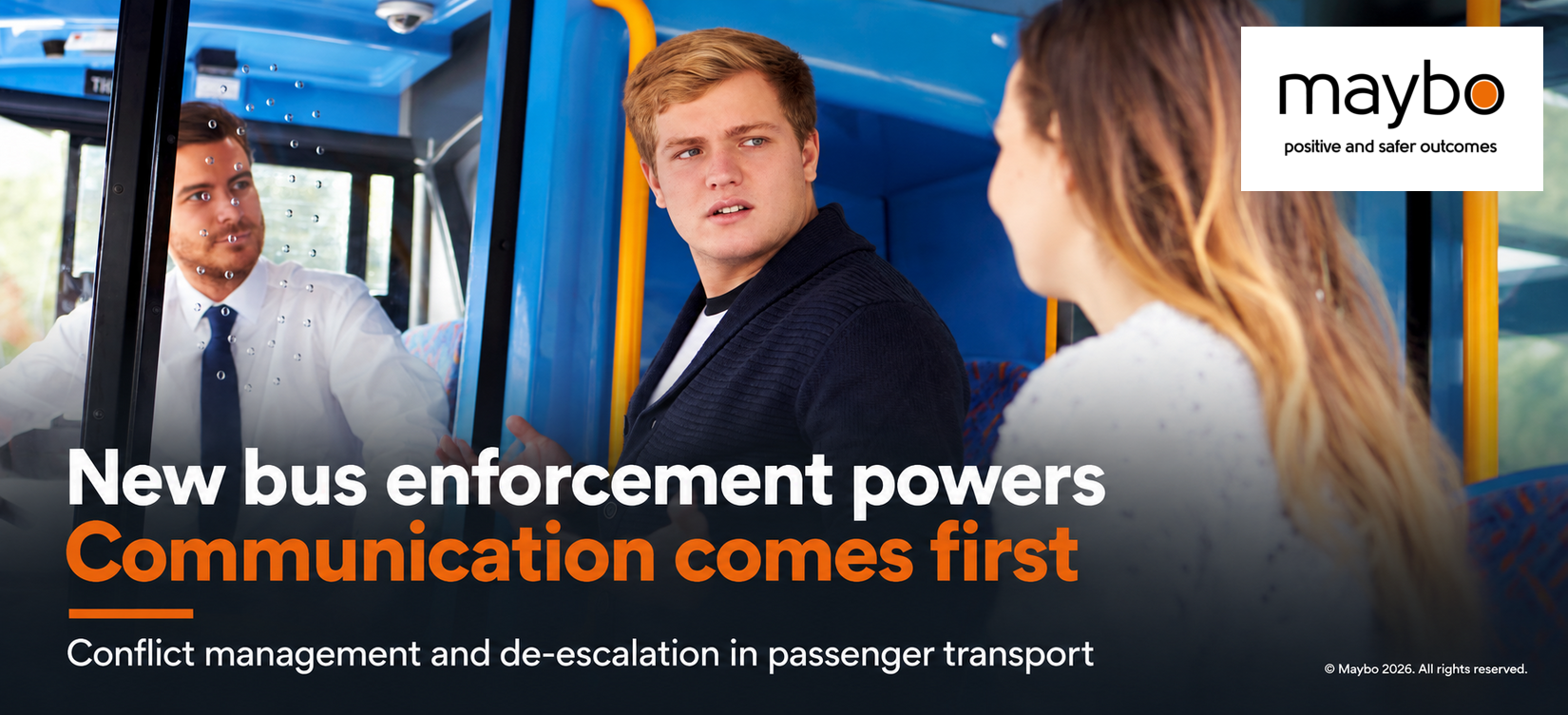
New powers to address antisocial behaviour on buses bring a practical challenge: helping authorised officers make sound decisions in difficult interactions. Communication, risk assessment and proportionate responses need to sit alongside legal authority.
New government guidance makes that connection explicit, identifying conflict management and assertiveness among the training topics for officers exercising these powers.
On 19 October 2026, the Department for Transport published guidance on using bus byelaws to tackle nuisance behaviour. It supports powers introduced through the Bus Services Act 2025, which came into force on 5 August 2026.
The framework allows local transport authorities in England to introduce byelaws addressing behaviour such as threatening conduct, vaping, littering and excessive noise. Each authority needs approval from the Secretary of State before enforcing its particular byelaws. Fixed penalty notices under the legislation are capped at £100.
The publication combines non-statutory advice on making byelaws with statutory guidance on enforcement. For transport leaders, a particularly significant part concerns the people entrusted to exercise the powers.
The statutory enforcement section says authorised officers must have appropriate training. It specifies that employees must receive adequate training for exercising their powers, including any statutory training, and says that training should cover:
This makes conflict management an explicit part of the government's expectations for officer preparation. It also highlights why a training plan needs to extend beyond knowing the byelaws and issuing a notice.
An officer may understand a rule perfectly and still need support to explain it calmly, recognise a change in risk or respond when someone cannot readily understand what is being asked of them.
The guidance strongly advocates Engage, Educate, Enforce: seek voluntary cooperation, explain the rules and their impact, then consider enforcement where those approaches have not worked. It cautions against blanket zero-tolerance penalties and disproportionate action.
These expectations should be reflected in practical learning. For example, a passenger playing loud audio may respond to a clear, respectful request. If the interaction becomes tense, the officer needs to reassess the situation and consider how to respond.
Training should give officers opportunities to practise how they introduce themselves, explain their role, listen, set clear boundaries and allow someone a reasonable opportunity to respond. Assertiveness should support clarity and confidence while maintaining respect.
A useful training question: can the officer explain why they chose to continue engaging, seek support or take an enforcement step, using what they observed in that particular situation?
The guidance warns that apparent intoxication may have other explanations, including medication effects or a medical condition. Officers should consider vulnerability and safeguarding alongside enforcement.
For learning and development teams, this is an opportunity to test the assumptions built into training scenarios. Does a learner immediately interpret confusion as refusal? Do they recognise when a different communication approach, more time or assistance may be needed?
A scenario can explore those decisions without asking staff to diagnose someone. The focus should be on observing carefully, acknowledging uncertainty and knowing how to access appropriate support. The needs of other passengers and the safety of staff remain part of that assessment.
The government's announcement is explicit: bus drivers will not be responsible for enforcing the new byelaws. Enforcement sits with authorised personnel, including transport safety officers and police. PCSOs are included where the relevant chief constable has locally approved their powers.
Organisations should reflect these distinctions in their training plans:
Conflict management training does not itself confer enforcement powers. Nor should a training certificate be treated as permission to use physical intervention in every difficult interaction. Any such response requires its own lawful basis, assessment of necessity and proportionality, appropriate competence and organisational oversight.
We recommend using the new guidance as a prompt for a practical review with operations, safety, learning and development, and relevant partners.
Can each team explain what it is expected and authorised to do, and when it should request assistance? Clear responsibilities help staff make decisions and support consistent responses across organisations.
Include the space, noise, time pressures and team arrangements that influence decisions on buses and at bus premises. Learning should reflect the situations employees encounter in their work.
Use realistic practice and feedback to explore communication, dynamic risk assessment and decision-making. Knowing an escalation procedure is valuable; being able to apply it during a difficult interaction requires practice.
Check that reporting, safeguarding, supervision and access to assistance work together. Employees need organisational arrangements that support the responses they have been trained to use.
Review incidents, complaints and staff feedback to identify where learning, procedures or support need to change. Include the experience of passengers and staff when assessing how the arrangements are working.
The introduction of new powers is not evidence that violence or antisocial behaviour will decrease. Organisations will need to examine what happens in practice and use that learning to inform their approach.
Maybo provides conflict management and personal safety training for the passenger transport sector. Our work includes understanding behaviour and reducing triggers, dynamic risk assessment, positive approaches and de-escalation, safer team and lone working, and recognising vulnerability.
For organisations preparing to implement bus byelaws, these capabilities are relevant to the communication and personal safety elements of officer preparation. Training should be selected around assessed needs and roles, alongside the legal, evidential, safeguarding and other specialist learning required for the local arrangements.
Whether you are preparing authorised officers, supporting drivers or reviewing how teams work together, a Maybo Client Success Partner can help you explore the risks your people face and the skills they need.
Speak to a Maybo Client Success Partner about your passenger transport training needs.
This article discusses guidance applying to England and was checked on 21 October 2026. Practical recommendations are Maybo commentary. Organisations should check the applicable legislation, approved local byelaws and their own legal and operational requirements.
© Maybo 2026. All rights reserved.
If you would like to discuss how we can help you please get in touch with one of our experts today
Comments
[Disqus comments for content1151]