Choose another country or region to
see content specific to your location
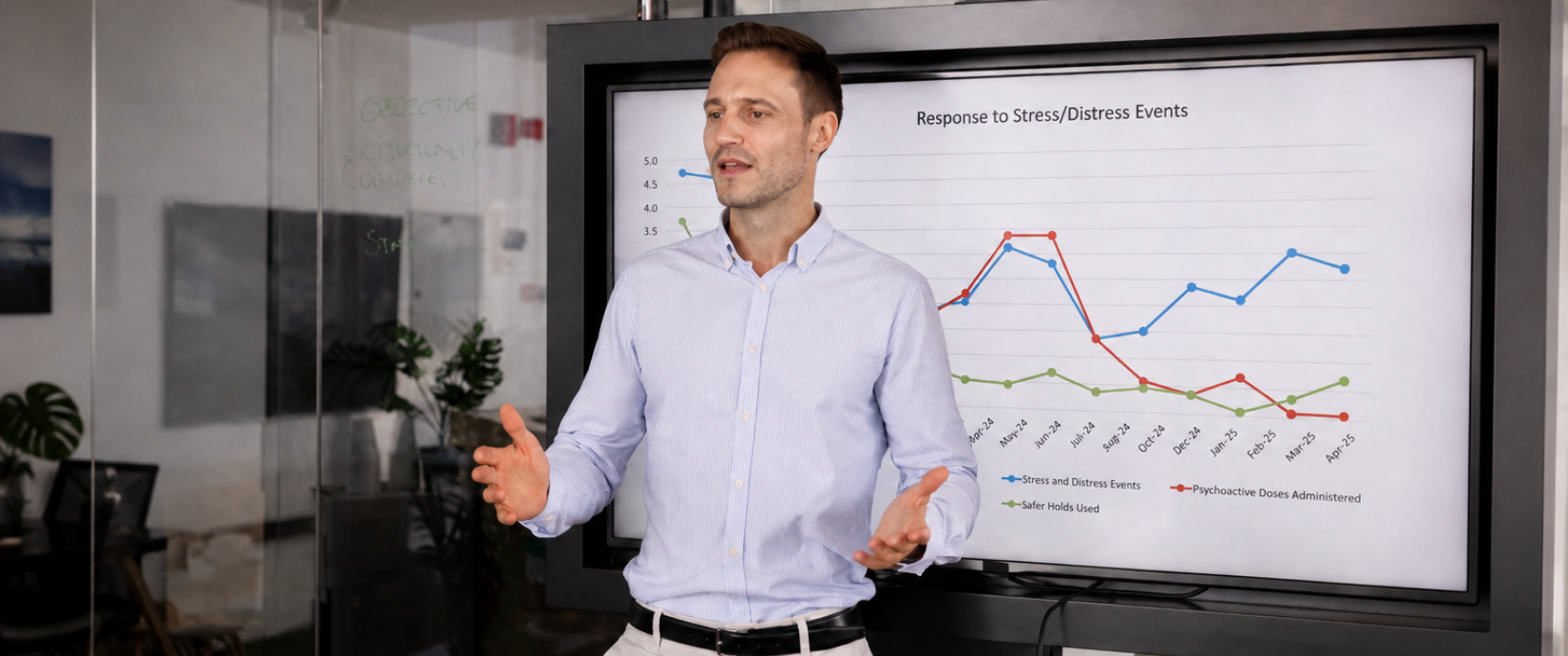
How open body language can build trust, reduce threat and create better conditions for learning
When most people think about body language, they think about confidence.
When we think about body language at Maybo, we think about something much more important:
Safety.
For many years, Open PALMS™ has been a core part of Maybo's approach to personal safety, conflict prevention and de-escalation. It helps communicate that we are approachable rather than confrontational, while also helping us maintain a safer position during close-contact interactions.
What many people don't realise is that the same body language that helps reduce conflict may also improve how effectively people learn.
Our brains are constantly scanning the people around us for signs of safety or threat.
Long before we've consciously processed someone's words, we've already started interpreting their posture, facial expression, tone of voice and hand movements.
From an evolutionary perspective, visible hands have always mattered. Hands can signal danger—or reassurance.
Open, relaxed hands communicate that we are not concealing a threat. Combined with calm movement, appropriate eye contact and a measured tone of voice, they help create a greater sense of psychological safety.
This matters because people are more likely to engage, listen and think clearly when they feel safe.
The principle underpins much of modern neuroscience, trauma-informed practice and effective de-escalation.
Interestingly, the benefits don't end when conflict is absent.
Body language expert Allan Pease has highlighted research suggesting that presenters who naturally use open palm gestures are often perceived as more authentic, trustworthy and engaging. In his presentations, he discusses evidence that audiences retain more information when speakers communicate using open, congruent body language rather than closed or defensive gestures.
The important message isn't simply that people remember more.
It's why they remember more.
When learners perceive a presenter as approachable and credible, they're more likely to remain engaged. Reduced defensiveness allows attention to shift away from evaluating the presenter and towards processing the information being shared.
Learning becomes easier because the presenter is communicating safety as well as knowledge.
This is one of the reasons Open PALMS™ remains such an important part of Maybo training.
In operational settings, it helps practitioners communicate calm, reduce perceived threat and maintain a safer position when working in close proximity to others.
In training environments, those same behaviours can help instructors build trust, increase engagement and create better conditions for learning.
The principle is remarkably consistent:
When people feel safer, they're generally better able to think, communicate and learn.
Whether you're delivering training, leading a meeting or supporting someone experiencing distress, consider these simple habits:
Open PALMS™ has always been about more than where we place our hands.
It represents an approach to communication that combines safety, respect and professionalism.
Whether you're helping someone through a difficult moment or delivering training to a room full of learners, the message is the same:
People are influenced not only by what we say, but by how we make them feel.
Sometimes, the most powerful communication happens before we say a single word.
Want to learn more about Allan Pease and his research on gestures?
Watch his TED Talks in the video link to the right.
If you would like to discuss how we can help you please get in touch with one of our experts today
Comments
[Disqus comments for content1134]