Choose another country or region to
see content specific to your location
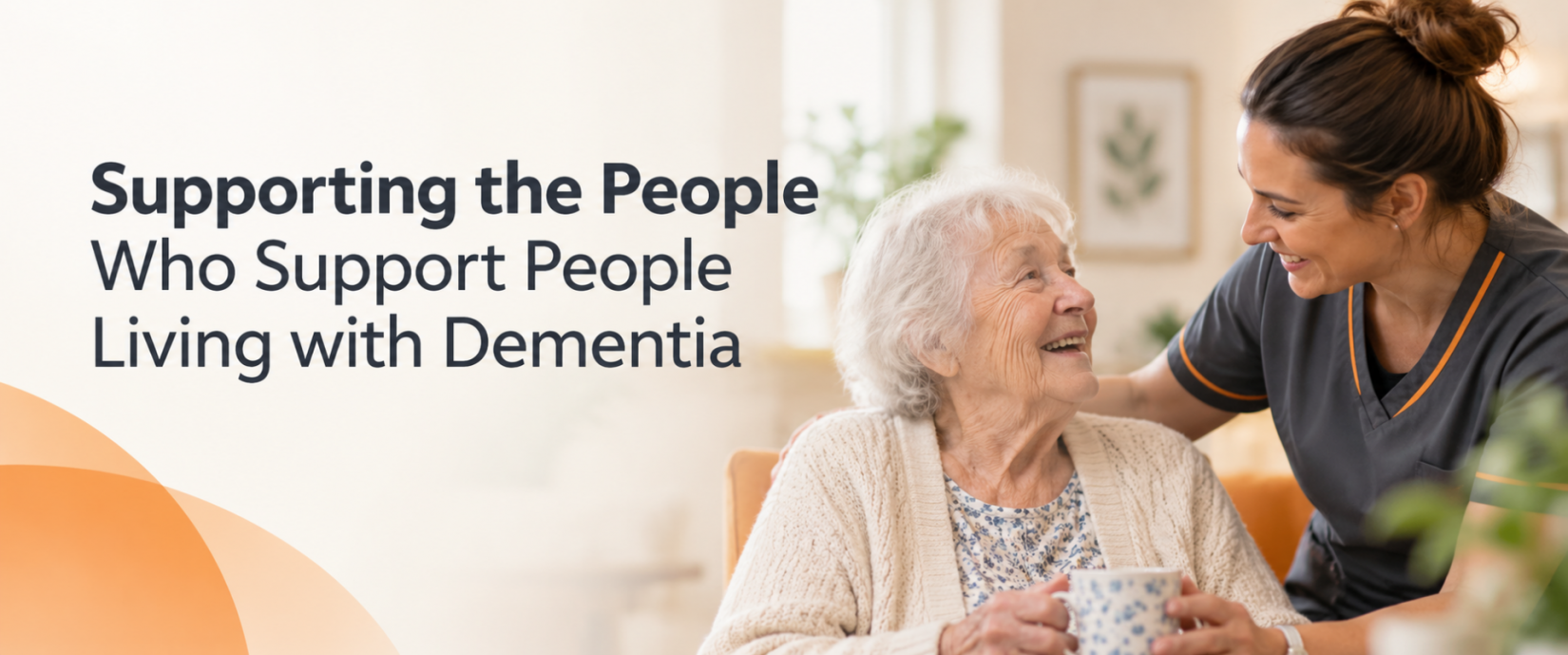
Caring for people living with dementia can take a real emotional and physical toll. Are we doing enough to support the people providing that care?
Burnout has been on the agenda in health and social care for years. But are we doing enough to support the people whose job it is to care for some of the most vulnerable people in our communities?
I recently read Gabor Maté's When the Body Says No. Among the many ideas in the book, one piece of research particularly stayed with me.
In a study published in The Lancet, researchers compared women who were caring for a relative with dementia with women of a similar age and socioeconomic background who were not providing that care.
The researchers created a small, controlled biopsy wound and measured how long it took to heal.
For the caregivers, healing took an average of 48.7 days.
For the comparison group, it took 39.3 days.
More than nine days longer.
The study was small, involving 26 women, and importantly these were family caregivers rather than professional care staff. We should therefore be careful about extrapolating the finding too far. But it provides a striking illustration of something increasingly supported by a much wider body of research: prolonged psychological stress is not simply something we experience emotionally. It can have physiological consequences too.
That made me think about the people who provide dementia care professionally.
People working in dementia care often build extraordinary relationships with the people they support.
They provide reassurance when someone is frightened. They try to understand distress when somebody can no longer easily explain what is wrong. They respond to repeated questions, confusion, accusations and changes in behaviour. They support people experiencing grief, pain, sensory difficulties and disorientation.
Sometimes they may be shouted at, threatened, grabbed, hit or pushed by somebody who is themselves frightened, confused or distressed.
And then they move on to the next person who needs them.
Understanding that behaviour may be a communication of distress is fundamental to good dementia care. But understanding why something happens does not mean that it has no impact on the person experiencing it.
That distinction matters.
There is a danger that, because care professionals understand dementia, distress and behaviour, we inadvertently expect them simply to absorb their experiences.
The latest Adult Social Care Workforce Survey in England provides an important window into this.
Almost half of the workforce — 46% — said they often or constantly worried about work outside their working hours. Nearly half said they were only sometimes or rarely able to look after themselves while at work.
Physical violence is also a significant occupational issue. Forty-one per cent of the adult social care workforce reported experiencing physical violence from somebody they cared for or supported at least once during the previous year. Among care workers and assistant care workers, the figure was 47%. The government report specifically recognises that aggression and violence can sometimes be associated with neurological conditions including dementia.
This does not mean we should characterise people living with dementia as dangerous. We absolutely should not.
It means we should acknowledge the reality and complexity of the work.
A dementia-specific systematic review has previously found staff stress and burnout to be associated with factors including feeling unsupported, perceptions of inadequate staffing, poor leadership and supporting residents displaying agitated behaviour. More recent research has gone further, describing occupational stress among professional dementia caregivers as a complex, systems-based issue involving psychological, physical and relational pressures rather than a simple problem located within individual employees.
That distinction should influence how organisations respond.
For several years, health and social care organisations have talked about resilience, wellbeing and burnout.
There is value in helping people understand stress, develop coping strategies and look after their own wellbeing.
But there is also a danger.
If we are not careful, "building resilience" can become another way of asking people to become better at tolerating unhealthy levels of pressure.
An exhausted member of staff does not necessarily need another online module telling them to practise self-care.
Sometimes they need sufficient staffing.
Sometimes they need a manager who listens.
Sometimes they need time to recover after a distressing incident.
Sometimes they need colleagues who can safely talk through what has happened without blame.
Sometimes they need better knowledge and skills so that situations which currently feel overwhelming become more understandable and manageable.
And sometimes the organisation needs to change something.
We rightly talk about person-centred care for people living with dementia.
Perhaps we also need to consider what a genuinely person-centred approach looks like for the people providing that care.
That could include:
These are not simply wellbeing interventions. They are part of creating safer systems of care.
In fact, they are closely connected.
CQC's review of dementia care in England highlighted the importance of well-trained, compassionate professionals who understand the individual and know how best to relate to them.
Providing that quality of care requires more than employing compassionate people.
We need to create conditions in which compassion can be sustained.
There are encouraging signs. Measures of wellbeing in the adult social care workforce have improved in several areas. But significant pressures remain. One quarter of respondents to the latest workforce survey said they would leave their organisation as soon as they could find another job. Among those considering leaving, the most frequently identified reason was the impact of stress and burnout on their health and wellbeing, cited by 60%.
That should make us think.
We spend considerable time asking how staff can provide compassionate, trauma-informed and person-centred support to people who may be frightened, distressed or overwhelmed.
Perhaps we need to ask the same question in the opposite direction.
Because if we want staff to remain curious rather than reactive, compassionate rather than exhausted, and able to see the person behind behaviour that can sometimes be challenging, then supporting their wellbeing cannot be something we think about only after somebody burns out.
It needs to be designed into the way dementia care is delivered.
The people receiving care deserve that.
And so do the people providing it.
If you would like to discuss how we can help you please get in touch with one of our experts today
Comments
[Disqus comments for content1145]